
If global investors are nervous about buying bonds at record low yield levels, spare a thought for strategic investors in Gilts. Not only are yields at record lows, but Gilt investors are noted for their pessimism towards the asset and a forthcoming binary risk – the Brexit vote – is finely balanced between being a left- and right-tail event. One comfort, however, is that many of the concerns about Gilts suffering from a “sell-UK” phenomena if Brexit becomes actualised are based on a common misconception about the role that foreign capital reflux plays in developed countries with floating currencies. While our bias is for a Remain victory and a removal of the Brexit risk premium from Gilts and the GBP, our conviction is low. Moreover, the weak global economy could limit the scale and longevity of a correction higher in Gilt yields in the event of a Remain win.
Category Archives: Monetary Policy Expansiveness
Avoiding the “Big Crunch” – policies to prevent a deflationary world
The policymaker response to the slow burning growth crisis of the global economy remains uncoordinated across geographies and reflationary levers. It is a path that leads to mounting non-linear risks for global markets and growth. The global economy needs a more effective and coordinated policy response, one that can raise aggregate demand but also prevent some of the increasingly persistent, cyclical restraints to economic growth becoming structural. While there are growing signs that some key countries may switch to more effective reflationary policies, in all too many cases the political barrier to appropriate policy remains high, and may first require a period of pronounced market and economic dislocation which could mean a pyrrhic victory for investor portfolios positioned for a switch to reflation. However, short-of a sufficiently bold policy reflation, there are a number of policies which could meaningfully improve cyclical and secular global growth and which may face a lower political barrier to implementation. Some of these are already emerging onto the global policy agenda, and have the potential to provide a much needed upside risk to growth and market performance.
US worker productivity – An example of how insufficient and misdirected reflationary policies can lad to a cyclical restraint to growth becoming a structural one
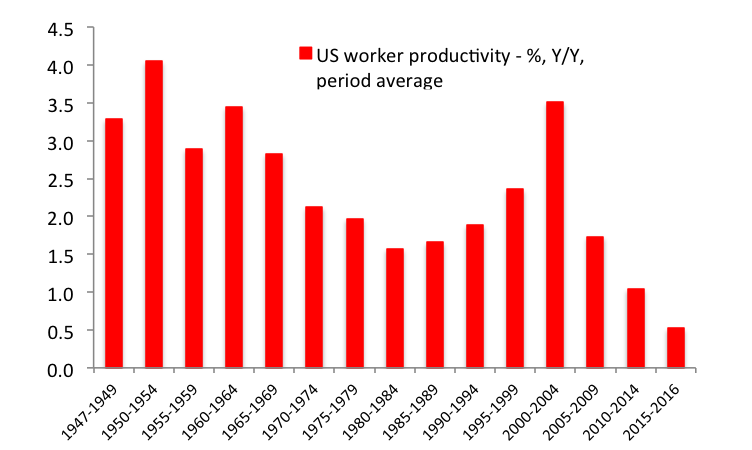
The full note is available for purchase directly from Event Horizon Research. To purchase the report please e-mail admin@eventhorizon-research.
The income-lite recovery trend – does the UK labour market recovery portend continued weak US wage growth?
There is a comfortable consensus with respect to the US economy: the labour market has recovered and rising wage inflation could risk the Fed’s inflation mandate were it not to continue to tighten policy. This may prove to be a dangerous assumption. There are many reasons to believe that the headline US unemployment rate remains a poor guide to wage inflation. In addition, there are numerous additional factors that are restraining wage growth in the US and indeed across many countries in the G10. A comparison to the UK is instructive. The UK labour market recovery has been far stronger and broader than that of the US and yet wage growth is less than half the pre-crisis and long-term trend. Something is afoot in the G10 and is being overlooked by the consensus. Analysing the UK experience shows that many of the factors restraining wage growth are applicable to the US. Were these factors to continue to restrain wage growth, the Fed’s tightening cycle could increasingly resemble to a policy error. Continue reading
Trading emerging market yield curves during currency shocks: a tale of two curves
We live in exceptional times, with many financial market prices and central bank policy settings at hitherto undreamed of levels. For many policy-makers trying to navigate their way through a persistently sluggish global economy, the conduct of monetary policy is complicated by their choice of prevailing exchange rate regime. Some significant trading opportunities can emerge from yield curve gyrations that are driven by FX policy, particularly during times of crisis, with Singapore and Korea providing two contrasting examples. These opportunities may be magnified by the prevailing strong-USD climate. The FX and yield curve relationship is also worth considering in the context of the perennial criticisms that are levelled at the crisis response policies proposed by the “Washington Consensus”, policies which so often attract complaints of a asymmetry between the options offered to developed and emerging market economies. Continue reading
China – The non-linear growth and FX risks of the structural slowdown
China’s investment-driven growth model is unsustainable in a post-crisis world of low global growth. Weak external demand magnifies the adverse side effects of this growth path – inefficient use of capital, excess industrial capacity, deflationary pressures, high corporate leverage. When these problems are allied to demographic challenges, China appears to be one of the world’s leading economies for which the secular stagnation argument could most readily apply. China’s slowdown is a challenge for the world economy given that China has accounted for nearly a third of global GDP growth since 2007. The challenge for China’s policy-makers is to address the non-linear risks implicit in a highly leveraged and deflationary economy shifting to a lower growth path. Monetary policy will need to remain exceptionally loose. Given this backdrop, there are growing downside risks to the CNY. Already Chinese institutions are increasing their holdings of overseas assets and the scale of China’s domestic liquidity is such that only a marginal increase in demand for foreign assets can swamp the balance of payments: China’s M2 approximates the combined M2 of the US, Germany and Japan. The CNY forward curve would appear to under-price the likely depreciation of the CNY over the next 12 months. Continue reading
Is the US economy really ready for a rate hike?
When assessing the outlook for The Fed’s monetary policy the clear consensus view is that the US economy is “good to go” for a hike, and that weakness in overseas economies is providing the key restraint to lift-off. This viewpoint could under-estimate the scale of the policy error were the Fed to hike rates over the coming months. Quite simply, the US economy continues to face structural headwinds that are restraining growth and inflation and which argue against policy tightening. These structural headwinds hold the potential to restrain household income growth and consumer demand and give a “data dependent” Fed, quite literally, a reason for pause. There is a strong potential for the Fed to keep rates unchanged in 2015 and 2016. In fact, the structural headwinds in the US increase the economy’s vulnerability to external shocks, meaning that a renewed policy easing is not beyond the pale. Rather than an overshoot, the current rally in US interest rate markets may have further to go over the coming months. Continue reading
Japan – A stir of echoes. Anticipating QQE3 and beyond
Japan’s economy is exhibiting the same critical trends that were seen during its long expansion in the 2000s. The expected consequence is an income-lite growth path that challenges the BOJ achieving its 2% inflation target. More policy stimulus is needed, and QQE3 (and beyond) is likely to be forthcoming. Fears that shortages of JGBs will preclude further stimulus and require a BOJ taper into 2016 are misplaced: there are potentially over JPY200trn of JGBs that the BOJ can buy. More QQE will help restore the trend of a weak-JPY and support the Nikkei while investors should expect fresh record lows in JGB yields. The current move in USD/JPY below 120 is an opportunity to scale into USD-longs while for those that can overcome the ticker-shock of low yields, the “old faithful” point of the JPY interest rate market – the JPY IRS 7fwd 3yr – is looking appealing. Continue reading