
We live in exceptional times, with many financial market prices and central bank policy settings at hitherto undreamed of levels. For many policy-makers trying to navigate their way through a persistently sluggish global economy, the conduct of monetary policy is complicated by their choice of prevailing exchange rate regime. Some significant trading opportunities can emerge from yield curve gyrations that are driven by FX policy, particularly during times of crisis, with Singapore and Korea providing two contrasting examples. These opportunities may be magnified by the prevailing strong-USD climate. The FX and yield curve relationship is also worth considering in the context of the perennial criticisms that are levelled at the crisis response policies proposed by the “Washington Consensus”, policies which so often attract complaints of a asymmetry between the options offered to developed and emerging market economies.
Currency policies determine yield curve trends
Dark clouds for emerging markets
Over the coming quarters, emerging markets may face significant headwinds. Global growth is expected to remain subdued, downside risks to China’s economy and the CNY are mounting, and the Fed appears primed to hike rates at a time when US inflation, wage growth and household develeraging trends argue for a delay. (Is the US really ready for a rate hike?) The potential for additional QE from the ECB and the BOJ would appear unequal to the task of offsetting these adverse trends, particularly as a diverging monetary policy path to the US by leading central banks looks set to extend the strong-USD trend which has proven so harmful to many emerging market policy-makers.
An FX focussed monetary policy can limit room for counter-cyclical policy
Economics 101 determines that how domestic yield curves react to these trends hinges on each country’s exchange rate policy. Those policy makers that do not have an exchange rate anchor for their monetary policy and where there is not a concern about high foreign debt levels resulting in a weak currency tightening financial conditions (via a higher debt burden in local currency terms), have the luxury of setting domestic interest rate settings on growth and inflation imperatives. Rates can be cut as currencies weaken, providing a double boost to growth, which naturally initially exaggerates currency weakness. (In an earlier note, I highlighted how China is likely to undertake a policy shift in favour of allowing the CNY to depreciate more than the FX forwards have implied in order to enable a domestic low interest rate and loose liquidity climate to be maintained. China: The non-linear FX and growth risks of the structural slowdown). However, for many countries, particularly in emerging markets, there is less ability to ignore exchange rate trends when setting monetary policy. Weaker currencies can equate to higher interest rates. Two Asian countries highlight these diverging trends: Singapore and Korea.
Singapore – the first curve to move negative this cycle
SGD IRS curve – one of the world’s most idiosyncratic curves
Singapore is an interesting example of a country where currency trends dictate yield curve dynamics for two reasons. Firstly, while often traded within an emerging market context, Singapore is a developed economy, where policy markets need not worry about the foreign debt implications of a weaker currency. Other factors determine the choice of an FX anchor. This makes Singapore a less obvious example of a country where FX movements determine yield curve trends. Secondly, of the world’s highly liquid yield curves, Singapore’s is among the most idiosyncratic.
An FX determined fixing rate for the yield curve
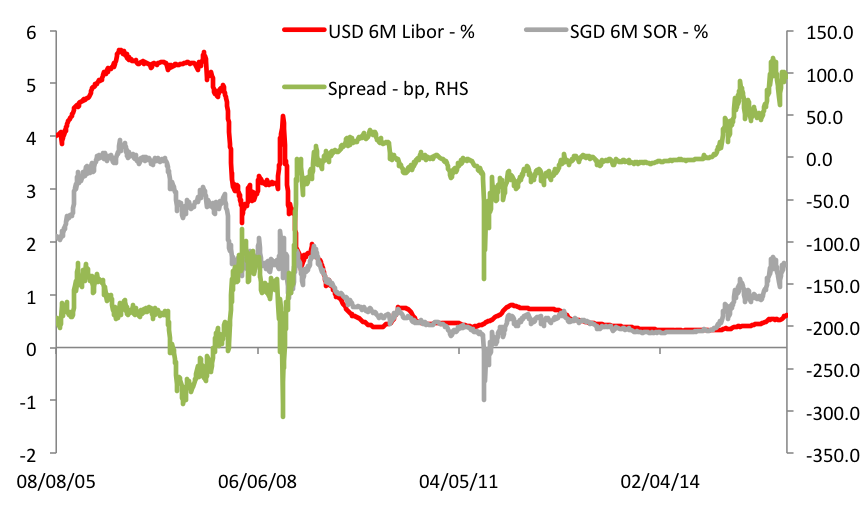
Two factors explain the idiosyncrasy of the SGD yield curve. 1) The Monetary Authority of Singapore (MAS) uses the trade weighted SGD as its monetary anchor, which renders domestic interest rates largely exogenous. This policy choice reflects the small open nature of the Singapore economy. 2) The fixing rate for the yield curve – and for much of the broader interest rate structure in the Singapore economy – is the 6-month swap offer rate, which is derived from the USD/SGD FX forwards. This combination leads to some counter-intuitive outcomes. When MAS tightens monetary policy via the exchange rate, investors need to “receive” interest rates as a stronger SGD will see the 6 month FX forward curve price in this appreciation and hence lower the fixing rate and reduce yields. This idiosyncrasy was most dramatically seen in August-September 2011 when Singapore became the first yield curve during this cycle to experience negative yields as the market priced in notable SGD appreciation against the USD. (Chart 1).
Chart 1: The SGD SOR fix is determined by the USD/SGD 6 month FX forwards
Source: Bloomberg
“Receive” rates whenever MAS tightening monetary policy and vice versa
However, the situation has reversed. Weak growth has twice this year seen the MAS reduce it’s targeted pace of SGD appreciation at a time when the USD has been globally strong. This has been a recipe for a weaker SGD against the USD, and hence a rising 6-month SOR fix, which has moved increasingly above the USD 6 month Libor. (Chart 1.) This divergence is expected to intensify over the coming months. While the Fed looks poised to hike rates, the scale of domestic liquidity and the regulatory-driven increase in demand for T-bills will mean that the effective Fed Funds is likely to continue to measure 12-13bp below the target Fed Funds. Moreover, the Fed will likely continue to downplay expectations of the pace of further tightening. Given diverging monetary policy trends between the US and the world’s other major economies (notably the Eurozone, Japan and China) the USD may increasingly be a key source of tightening monetary conditions in the US as the strong USD trend is extended. This would imply a further widening of the spread between the SGD and USD fixing rates. Were MAS to respond to weak growth by easing monetary policy and going to a zero appreciation path for the SGD TWI, or even a depreciation path, then the movement of the SGD fixing rate moving above USD Libor would be even greater.
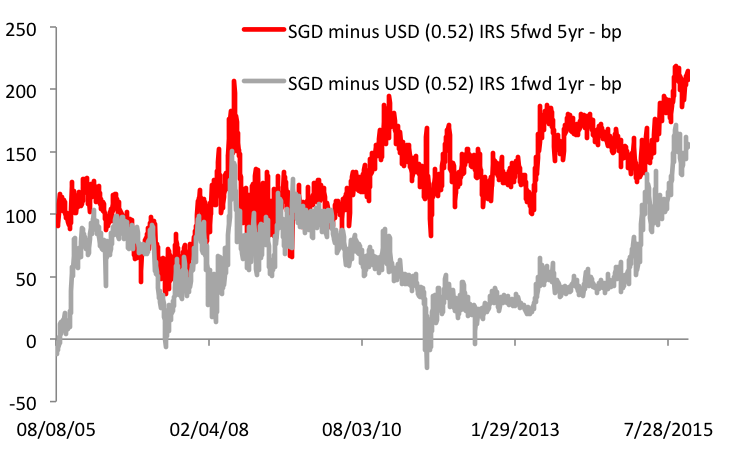
Chart 2: The drivers of the SGD IRS fix, means that recession weighted spreads provide an appealing way to position for out/under-performance vs. USD rates.
Source: Bloomberg
SGD IRS curve under-performance of the USD curve – position via regression weights
Periods when the SGD and USD fixing rate trends diverge tend to be persistent, which reflects how they are often underpinned by multi-quarter and multi-year business cycle and policy trends. This creates interesting, risk-reward opportunities on the SGD curve, in particular around the under/ out-performance of SGD interest rates vs. USD rates. The clearest way to see these trends is to regression weight the USD leg of a spread trade. This reflects how the SGD and USD markets are naturally highly correlated (r2 of 0.79 over the past 10 years), but that the SGD leg remains the higher beta component of the pair. To strip-out this beta effect, the USD leg of an IRS spread trade can by weighted by 0.52. Chart 2 shows how this regression weighted spread trade and highlights just how much SGD interest rates have under-performed USD rates since the SGD fixing rate moved above USD 6M Libor. A spread trade also reduces the negative carry of “paid positions at the front-end of the curve: paying the SGD IRS 1fwd 1yr has a negative slide of 56bp over 12 months, which the regression weighted spread trade has a negative slide of 24bp. This trend of SGD under-performance of the US may have further to run over the coming months, albeit – as I discuss below – primarily at the front-end of the curve. (The optically appealing carry of receiving SGD rates in the Reds-to-Greens has rendered this position a pain-trade for many investors over the past 12 months.)
The impact of the SGD fixing rate on the Singapore property market…
One dynamic, which could increasingly impact the back-end of the SGD yield curve, is the weakening Singapore economy. (Naturally, further out along the curve macro-variables have a relatively larger effect over determining yield levels than do the fixing rates). Singapore’s open economy is adversely affected by weak global growth and the deceleration of global trade. GDP grew by 1.9% Y/Y in Q3 2015, down from 2.8% a year earlier and 5.4% in Q3 2013. In addition, the economy is experiencing rising interest rates as so many commercial lending rates are tied to the SOR. This is a particular concern for Singapore’s over-heated property market, which has benefitted from exceptionally low interest rates for the best part of a decade, The property market is already cooling and higher lending rates risk accelerating this trend. (The official residential property price index has fallen 8.0% since it’s peak in Q3 2013, but had previously increased 62.2% since a post crisis low in Q2 2009.) The downside risks to the Singapore property market are growing. While the authorities have the ability to remove some of the prudential measures (higher transaction tax, increased restrictions on foreign ownership) put in place during the run-up in property prices to help stabilise the market, it is hard to draw much comfort from this possibility since the measures proved so ineffective is slowing the initial run-up in prices.
…look for continued curve flattening
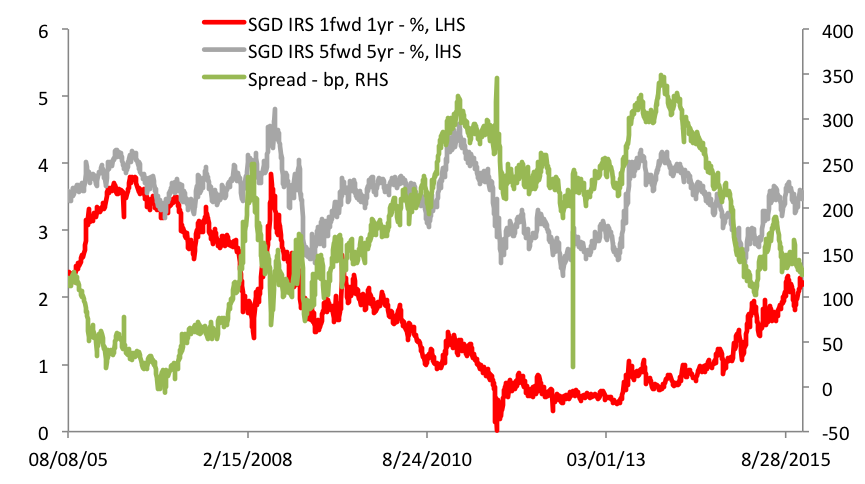
This means that the back-end of the SGD curve could start to see lower correlations to the fixing rate and US markets. Hence, the regression weighted spread trades to the US around the 5-10 year part of the curve may not perform as strongly as those at the front-end. Moreover, the Singapore curve should continue to flatten. The spread between the SGD 1fwd 1yr and the SGD 5fwd 5yr is currently 122bp, and in forward space is 82bp in 1-year’s time. The spot SGD IRS 1fwd 1yr vs. 5fwd 5yr spread has the potential to markedly outperform the forward curve and flatten towards 0-25bp. (Chart 3). In short, the interest rate corollary of a long-USD/SGD position is a SGD IRS curve flattener and paying a regression weighted a spread trade to the US at the front-end.
Chart 3: The SGD curve is expected to continue to flatten
Source: Bloomberg
Korea – more traditional curve dynamics and a central bank delivering fresh record low interest rates
Korea – FX trends determine monetary policy indirectly
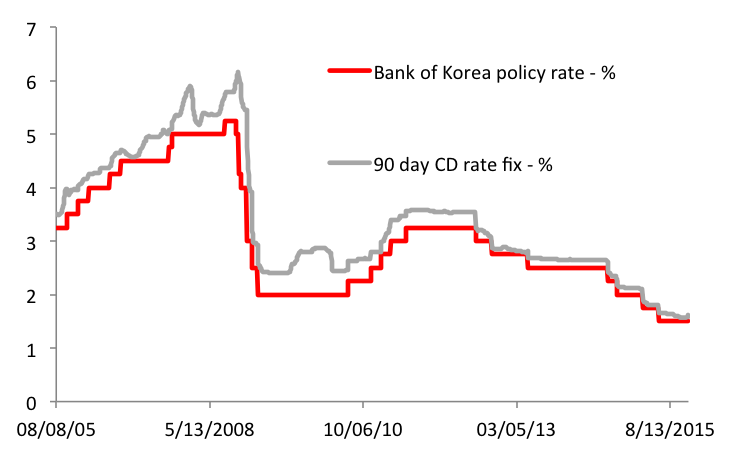
A contrast to Singapore is Korea. Bank of Korea (BOK) monetary policy trends are focussed on domestic growth and inflation trends, with the currency impacting those considerations only to the extent that FX fluctuations alter the underlying business cycle. Moreover, the fixing rate for the yield curve – the 3-month certificate of deposit rate – is driven by domestic liquidity conditions rather than the exchange rate. With the BoK no longer intervening heavily in the FX market (over the past 12 months, FX reserves have risen by 1.6% or USD5.9bn to USD369.6bn, which is a move that FX effects alone could have driven), the lack of FX reserve depletion means that a weak currency vs. the USD does not tighten domestic liquidity conditions as it does not affect the KRW money supply. Hence the CD fixes are relatively insensitive to exchange rate gyrations. As such, since the liquidity shocks of the financial crisis, the CD rate fix has closely tracked the BOK policy rate. (Chart 4.) This enables the Korean yield curve to operate as a traditional G10 market would: investors receive rates into a slowing economy and a central bank easing cycle.
Chart 4: Following past liquidity shocks, a flexible FX policy by the BOK has allowed the CD rate fix to track the policy rate
Source: Bloomberg
The risks to Korea stemming form Abenomics
The Korean economy clearly needs low interest rates. The BOK has lowered it’s policy rate to a succession of fresh record lows (currently 1.5%), and has accepted the subsequent impact of this policy on accelerating KRW weakness vs. the USD during times when Asian currencies have been under pressure. In fact, the BOK is having to deal with some difficult currency cross winds. The strong USD trend has pushed USD/KRW higher over the past 18 months, despite the periods of counter-trend KRW strength during periods when emerging market sentiment has stabilised. However, around half of Korean exports (which in 3 month moving average terms declined -9.7% Y/Y in November) compete directly with Japanese products in third markets. As such, the pronounced JPY weakness during the Abenomics has seen a significant appreciation of the KRW against the JPY. JPY/KRW is the key exchange rate for determining Korean export competitiveness, and a higher cross rate is a tightening of monetary conditions that requires a policy-offset via interest rates. (Since Abenomics, the KRW has appreciated 23.8% against the JPY, despite a surge in USD/KRW over this period.) Again, the Bok does not target monetary policy on increasing JPY/KRW, but rather on the economic impact of the pronounced slide in this exchange rate in recent years.
Look for fresh lows in yields
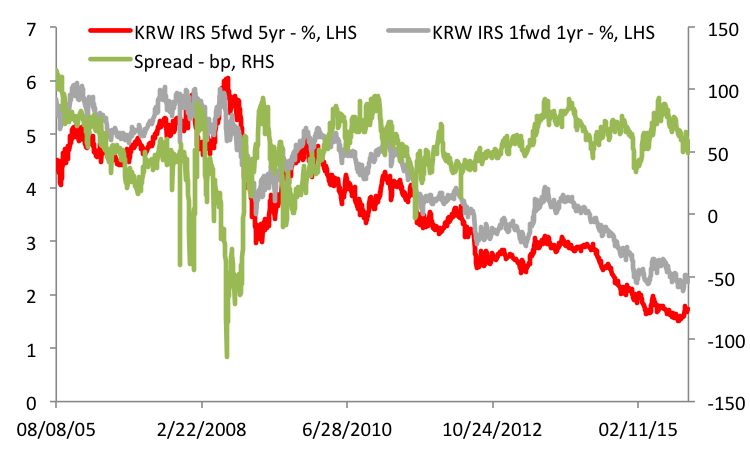
With Korean growth continuing to be pressured, and with the likelihood of a further tightening of monetary conditions via a lower JPY/KRW if – as I expect – the Bank of Japan unleashes QQE3, further record low interest rates will be seen. The KRW government bond and IRS curves would be expected to trade in this environment as would a traditional G10 curve: front-end out-performing into an easing cycle, with the curve initially steepening; subsequent flattening if growth does not pick-up and investors anticipate a prolonged period of low rates, until attention turns to the possibility for further cuts; an eventual bearish flattening when the economic and monetary policy cycle is presumed to have turned. The currency is only an indirect driver of these trends. If anything, a lower JPY/KRW is a reason for investors to receive KRW interest rates due to expectations that the BOK policy response may be looser for longer monetary policy amid a consequent weakening economy. Given the global climate, corrections higher in yields in Korea still look to be opportunities to go long/ receive rates as the long trend of lower KRW yields is not yet complete.
Chart 5: The KRW IRS curve acts as a G10 curve into a monetary easing cycle
Source: Bloomberg
The appropriateness of the “Washington Consensus” crisis response
An asymmetric crisis policy response?
The issue of how FX policy trends influence monetary policy and yield curve movements is a controversial one, and is not a dilemma that is the exclusive preserve of emerging market policy-makers. We need look no further than the monetary policy challenges that the SNB has faced in trying to stem CHF weakness, or the amplification of the Euro crisis caused by individual member countries being unable to implement a suitable monetary policy. However, the issue is particularly controversial for emerging markets and at the heart of the debate is the view that these countries, when facing an economic crisis, are forced to repudiate counter-cyclical policy options and instead focus on stabilisation policies which often involve stabilising an exchange rate by hiking interest rates into a recession. The IMF is naturally at the forefront of this “Washington Consensus”, and this policy is often used as criticism of multi-lateral agencies implementing a double standard with respect to policy responses to a crisis.
The choice is often, fight currency weakness or face a debt default
However, rather than a double-standard, the need for stabilisation in some countries reflects issues such as the prevailing level of a country’s foreign debt that and hence, as noted above, whether a weaker currency actually tightens monetary conditions by increasing the local currency debt burden on the country. For such countries the choice is not as simple as raising or lowering interest rates or fighting or accepting currency weakness. Rather, the debate is often about a country’s appetite to impose capital controls or implement a debt restructuring in order to reduce the adverse consequences of a weaker currency, both of which risk weakening market access. For many countries, this cost is considered too high and hence pro-cyclical stabilisation policies are followed. However, there are also countries such as Iceland, which responded to the financial crisis with the default and capital control option. If we see a renewed bout of emerging market weakness, one key risk is that more countries may see their policy-makers once more question the virtue of FX trends influencing interest rate policies, and consider currently unpalatable options.