
A fragile world economy that faces an ever more daunting battle to combat deflation and where there is a growing concern that traditional reflationary policy levers are reaching their effective limits, could have done without another event shock. And yet that is exactly what it has received as the UK voted for Brexit. To make it worse, the subsequent political unravelling in the UK had created the impression that the country is rudderless as it seeks to navigate through the dangerous path the electorate has chosen. The PM has resigned and remains as a care-taker, the main opposition party is in turmoil with a leader at best luke-warm to Europe and whose consistently weak performance has sparked internecine warfare in the party, while it has become clear that the Brexit leaders do not have a plan of implementation or are even aware of the full implications of Brexit. The market turmoil appears fully justified. That said, for international markets the Brexit impact is likely to be more akin to the December-February market rout – painful, deep but finite. Brexit is not the trigger point to ”The Big One”, the financial crisis we fear is coming. However, for the UK – unless reason prevails and Article 50 is not triggered – the outlook is bleak. GBP has enormous downside potential, while Gilts may become Bund-like in that they are viewed as collateral rather than yield instruments. 10-yr Gilts could trade flat to a lowered policy rate.
Well that was not meant to happen
The Leave campaign won. We were not expecting that. Heading into the vote we knew that the result was uncertain, and following our “don’t know, don’t trade” mantra had declined to offer high conviction trade ideas in the GBP market heading into the vote. (Brexit, Gilts, the GBP and the grudging longs.) Nonetheless, we still expected Brexit to be avoided and anticipated a subsequent decline in global market risk premia. To quote the great Homer – “Doh!”. The subsequent market reaction has been all that we feared were Brexit to occur, with price action made worse by the political vacuum in the UK (PM having resigned, Brexit leaders being revealed to have no plan about the post vote transition, Labour in disarray). To paraphrase an Irish saying, “if you wanted to navigate your way through a period of economic and political turmoil, you would not start here”.
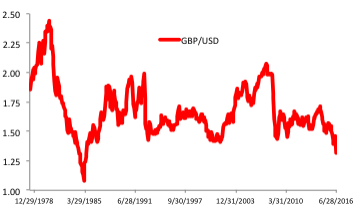
The slide in GBP. We have been at these levels before, but…
Source: Bloomberg
The political consequences of the income-lite recovery
The result adds even greater force to a defining theme of our analysis – the economic, market and political implications of the income-lite economic recovery. We have highlighted a structural break that has taken place in developed markets since the crisis in terms of income growth, and how this has profound implications for economic growth, price stability, the conduct of monetary policy and the susceptibility of an electorate to insurgent political movements. On the latter point we had focussed on the rise of politicians such as Donald Trump and the leftist political parties in Europe. We had doubted that the anger felt by large swathes of the population would lead to Brexit. We were wrong, meaning that we have under-estimated the scale of the slow-burning growth and household income crisis dominating developed economies. A Trump presidency seems less implausible post Brexit. The need for reflation policies that are coordinated across countries and reflationary levers is even more urgent.( The Big Crunch – policies to avert a deflationary world.)
Is this THE BIG ONE?
As Brexit roils markets, the obvious question is whether this is “The Big One” that will lead to the renewed and sustained financial crisis that we expect to unfold over the next 12-24 months. It has the potential to be such given that the shock of Brexit impacts a global economy that is in an exceptionally fragile state and where many policy-makers feel they are approaching the limit of traditional counter-cyclical policy levers. (Can someone please remind me why the Fed felt the need to initiate a tightening cycle, and why it was cheered by the commentariat for doing so? After all, Brexit was merely one of many potential event shocks facing the world economy, and was by no means the greatest threat to growth and financial stability.) ( Is the US economy really ready for a rate hike?.)
While the UK economy is far too small to have a notable affect of global demand swings, Brexit does have numerous other possible channels of contagion: the Brexit-related uncertainty weakening growth in the far larger Eurozone economy; a slide in financial sector share prices feeding through to a reduced risk appetite and more cautious approach to balance sheet application; a risk aversion driven by a stronger-USD increasing emerging market risk; US corporates and consumers adjusted to a perceived higher probability for a Trump presidency.
No – but it’s bad. And THE BIG ONE is still coming, but just not yet.
In our view, Brexit is not “The Big One”. It is not the trigger for a sustained financial crisis that we still believe is coming. The triggers for that are in our view more likely to be a combination of:
- A marked US economic downturn.
- A downturn in developed market corporate earnings reaching the point where credit risk concerns rise and where companies try and preserve margins by shedding labour. (It is worth noting that in many developed countries such as the US, the driving force behind higher unit labour costs is low productivity rather than higher wages. The reaction function of companies to lower profit margins is very different when unit labour costs are not being pushed higher by a tight labour market increasing wages but instead by low productivity. In the latter scenario, labour is shed more easily.)
- A Chinese FX policy shift
- A broader emerging market growth shock and market liquidity event.
- The market moves triggered by the factors above are expected to be accelerated by a “market strategy crash”, as an array of in vogue investment styles (momentum based quant strategies, VRP short gamma strategies, Risk Parity, disguised risk premia harvesting strategies) reach an adverse tipping point at a similar time as they encounter a market with diminished liquidity and a rising risk premium.
Policies to ease the international impact of Brexit
Brexit has the potential to trigger many of these events, but we feel that the problem is more containable. There can be a clear policy response in Europe to help ease the uncertainty (ECB QE will become an ever more persistent feature of the European financial markets, and the scarcity of Bunds will increase). Global central banks can help address any emerging liquidity strains in their respective banking sectors and isolate UK banks exposed to the deteriorating UK economy as the core vulnerable institutions. There remains the possibility, slender, not non-negligible, that the absence of a plan for Brexit, the refutation of all of the key Leave campaign pledges, the unfolding economic and financial chaos that the much derided “exports” warned about, the risk to the UK as a politically contiguous nation state all result in Article 50 not being triggered.
Brexit may be a December 2015/ February 2016 type event
For non-UK markets, the Brexit effect is likely to be akin to the December to February slide in risk markets in our view. Brutal, painful, and something that adds to underlying vulnerability but something that can be recovered from. We will not use the popular analogy of Brexit being like Bear Stearns rather than Lehman, as the period after Bear Stearns collapsed was the strangest and most surreal period in the market this analyst has seen in his entire career: when the world economy was heading for a non-linear growth, liquidity and solvency crisis, the market was pricing in rate hikes, Bernanke was turning hawkish, inflation was a growing concern and commodities were surging! It was so very surreal. So yes, this is not like Bear Stearns!
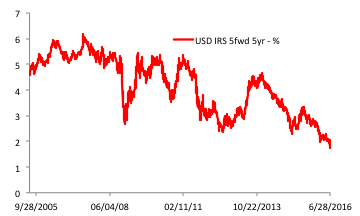
The pivot point for the USD IRS 5fwd 5yr is now 1.75%: receive at 2.0% and look to pay at 1.50%.
Source:Bloomberg
Long USD. Receive Rates, with the USD IRS 5fwd 5yr pivot to decline to 1.75%.
If we expect this to be a brutal but finite period of risk aversion for global markets, what trades stand out? The obvious trades are to be received rates, in core-developed markets. Brexit is a sufficient spark for us to look for our anticipated pivot point in the trading range for the USD IRS 5fwd 5yr to decline to 1.75% from 2.0%, while Bunds (10yr yield is currently -0.09%) will go increasingly negative, especially since they became collateral rather than yield instruments over 3 years ago.(The Fed, real yields, a declining neutral rate and the need for core “received” positions). From an FX standpoint, the strong-USD trend will be established. Aside from the obvious decline in GBP/USD, short EUR/USD positions will make clear sense as the Eurozone gets caught up in the UK’s act of self-harm, while emerging market currencies will be a high beta play. Long USD/KRW, looking for a move above 1,200 appears attractive, while the USD/CNY NDF (not the CNH market where policy squeeze and capital control risks are greater) will march higher.
Lack of confidence on the BoJ’s ability to spur USD demand will see the JPY trade as a save-haven currency, for now
In Japan, the markets lack of confidence on the bank of Japan’s ability to generate sufficient USD-demand is likely to see the JPY continue to trade as a risk aversion safe haven, which will mean yet further decline in JGB yields, and a continued need to stay received the more stable IRS market. Our favoured JPY interest rate, receiving the JPY IRS 7fwd 3yr, has continued its steady and stable march lower, and at 0.08% is effectively at our target of 0%. This has the potential to move lower still, towards -20bp.
Eurostoxx vulnerable to an end of the already fading Eurozone economic recovery story
Equity markets will clearly see further losses led by bank stocks, which will, impact credit markets adversely. Eurostoxx appears particularly risks outside of the UK given that sentiment in the Eurozone had been bolstered by the cyclical pick-up in growth from last year as lower oil prices had boosted real disposable incomes which in turn spurred increased consumptions. The recent recovery in oil prices is already winnowing away real disposable income gains, and the Brexit uncertainty now risks removing this one source of optimism in the Eurozone, the cyclical growth pick-up.
Better late than early for the market rebound
Our view is that many of these moves can ultimately be faded on a tactical basis over the coming weeks and months, but the lessons of event shocks that take place in a fragile global economy an in markets facing ever diminishing liquidity, is that it’s better to be a bit late than a bit early to a retracement trade.
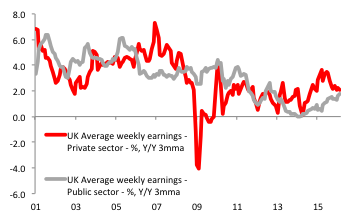
Brexit will exacerbate the UK’s inability to sustain 2+% income growth post crisis, and thereby maintain the income-lite recovery
Source: CEIC
The UK effects – fiscal reflation is required, but is unlikely to be seen. A return to QE more likely, and less useful.
For the UK, the market consequences of Brexit are far more protracted. Assuming that the UK continues down the Brexit path – which is by no means certain – then there are certain core assumptions that need to be made:
- The pervading economic uncertainty will likely see a reduction in already weak levels of corporate investment.
- Consumers will likely increase their savings ratios amid greater uncertainty.
- Financial institutions with a sizable presence in the UK will face downward pressure on share prices, which will fuel greater caution with respect to balance sheet deployment, which will equate to a tightening of monetary conditions.
- A recession looks increasingly likely in 2017 as the lagged effects of this uncertainty is felt.
- There is also the looming added event shock of a break-up on the UK if Scotland pushes for a second referendum, one that would have a greater probability of success given that independence now carries with it a powerful practical proposition – leave the UK to remain in Europe.
- Into this economic scenario there is a compelling need for a fiscal stimulus package (ideally of 1-2% of GDP per year for the next 2-3 years) to help smooth demand, and with the zero bound problem likely to be exacerbated by recession, there is no reason for the government to worry about a yield impact of increased public spending, foreign capital flight or the on-going wave of UK sovereign downgrades. Brett, Gilts, the GBP and the grudging longs
- However, a belief in the need to reduce the budget deficit is deep rooted within the Conservative party. At a time when the cyclical slowdown will lower revenue and inflate the budget deficit, any fiscal stimulus is likely to be half-hearted and insufficient.
- Monetary policy will therefore once again have to take the brunt of counter cyclical response, despite money multipliers being far lower than fiscal multipliers in the current UK economy. While the Bank of England may lower its 0.5% base rate, the bulk of the policy stimulus would likely come from a resumption of QE.
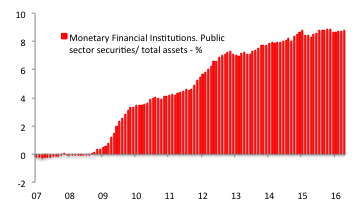
Risk aversion and QE is likely to lead to a renewed spike in risk-free asset holdings of financial institutions in absolute terms and relative to asset size
Source: CEIC
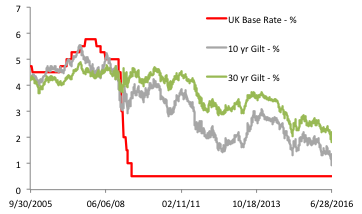
Gilts to become Bund like collateral instruments – 10yr to trade flat to the policy rate?
In this scenario, Gilts would continue to benefit from over-whelming demand amid risk aversion, weakness in GBP risk assets, as recession risks loom and as the market prices in a resumption of QE. Gilts could come to resemble Bunds in that they adopt characteristics more attuned to a collateral instruments rather than a yield product, in which case 10-year Gilts could move flat to the policy rate at 50bp, and below this level is the Bank of England lowers rates, which would appear likely.
In a Brexit scenario, Gilts will become “Bund-like” collateral rather than yield instruments: 10yrs to trade flat to a lowered policy rate.
Source: CEIC
The GBP faces the potential for far greater downside than has been seen since the vote
The GBP will clearly extend its under-valuation with initial weakness against the USD and JPY likely to see the larger moves. Of the two, GBP/USD would be our favoured way of playing GBP weakness given that there remain the potential for Brexit to push the bank of Japan into initiating QQE3. Rather than levels, the period of GBP weakness may persist until there is at least a sense of how the investment parameters unfold. At present, with a PM having resigned, a Labour Party in disarray, a Brexit campaign leadership revealing itself to have no plan of action nor even a full understanding of the practicalities of Brexit, it is difficult to even know what the parameters for investment decisions are. GBP/USD remains a sell on rallies until some clarity emerges, and for anyone who has traded or analysed classic non-linear, emerging market type event shocks before and the tendency for markets to markedly overshoot, GBP/USD weakness could extend far below 1.30 and indeed 1.20.
The hoped-for option with a non-negligible risk – sanity prevails and Article 50 is not rejiggered.
The positive scenario is that the UK pulls back from the brink and Article 50 is not triggered. This is possible since it is becoming increasingly clear that the key Brexit leaders did not anticipate on success in the referendum and hence it may not be an option they want. Moreover, many Leave voters feel angry that all of the core campaign policy platforms they supported proved to be false. For many voters, this constitutes a material change of circumstances. This is a scenario that would leave the UK weakened – and quite frankly something of an international source of ridicule – but far better embarrassment than the chaos that the vote has brought. However, right now, it’s far too early to predict such an outcome. Instead, we have to work with the scenario of Brexit continuing, which means sustained market weakness (other than Gilts) and a slide in the GBP.
Pingback: Brexit – “Exit, pursued by a bear” and the need to stay short-GBP and received GBP rates | Event Horizon Research