
If global investors are nervous about buying bonds at record low yield levels, spare a thought for strategic investors in Gilts. Not only are yields at record lows, but Gilt investors are noted for their pessimism towards the asset and a forthcoming binary risk – the Brexit vote – is finely balanced between being a left- and right-tail event. One comfort, however, is that many of the concerns about Gilts suffering from a “sell-UK” phenomena if Brexit becomes actualised are based on a common misconception about the role that foreign capital reflux plays in developed countries with floating currencies. While our bias is for a Remain victory and a removal of the Brexit risk premium from Gilts and the GBP, our conviction is low. Moreover, the weak global economy could limit the scale and longevity of a correction higher in Gilt yields in the event of a Remain win.
Gilt returns and the grudging longs
Far from basking in their outsized total returns, many UK institutional holders of Gilts may be best described as “grudging longs”. This reflects the peculiar investor perspective of the UK Gilt market, which sees many practitioners have an instinctive bearish bias on the asset and where fears over risks such as inflation or a hawkish Bank of England surprise are never far from the surface.
Brexit concerns add wings to the Gilt rally
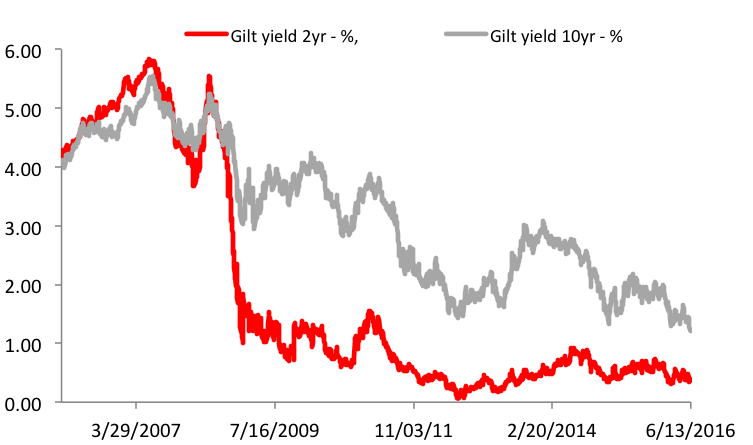
Brexit has been one of the key concerns for holders of Gilts given the potential for such an outcome to result in foreign capital reflux. These fears have been assuaged by the tendency of the Gilt rally to be extended in lock step with opinion polls pointing to a higher potential for Brexit. With opinion polls showing a lead for the Brexit camp, 10yr Gilt yields have reached a succession of fresh record lows as they approach 1.20%, while the 2s30s spread has flattened to 166bp, levels not seen since October 2008 when the world was absorbing the Lehman collapse and where the Bank of England was poised to slash interest rates. (Chart 1.)
Chart 1. Brexit gains add to the Gilt rally.
Source: Bloomberg
Concerns linger of a “sell-UK” trend
Yet for many, concerns linger that the actuality of a Brexit victory would confound this price action and lead to a “sell-UK” phenomenon, as an increased risk premia would be embedded in all GBP markets. Talk of a UK “currency crisis” driven by foreign capital reflux often follows discussions of Brexit. It is easy to see why there are persistent concerns regarding the potential vulnerability of GBP and UK financial assets to a change in investor sentiment:
- The UK current account deficit is trending higher and measured 5.2% of GDP in 2015 and 7.0% in Q4 2015 alone.
- At the end of 2015, foreigners owned 27.3% of outstanding UK Gilts, up from 24.7% a year earlier.
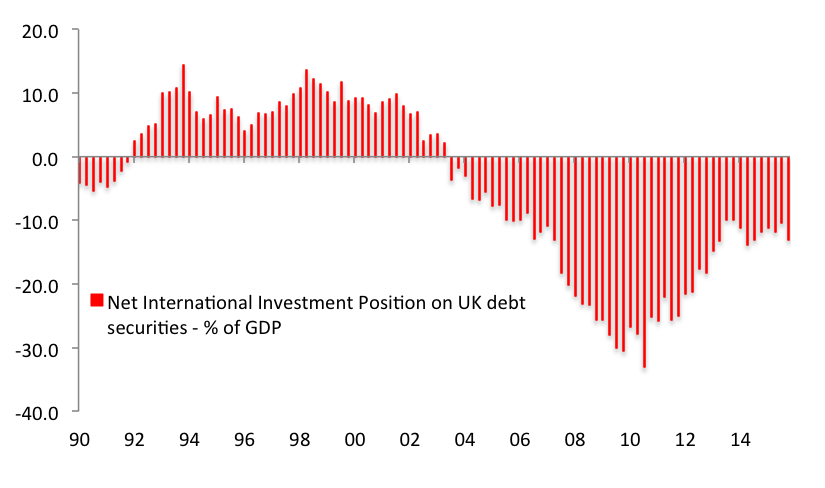
- While the UK Net International Investment Position is fairly balanced and showed a deficit of just -3.5% of GDP in 2015, the sub-category for debt securities shows a deficit amounting to -13.1% of GDP. This is a measure of how great the value of foreign holdings of GBP debt securities is relative to UK holdings of foreign debt securities. (Chart 2.)
Chart 2. The UK NIIP for debt products highlights a Brexit vulnerability for credit products.
Source: CEIC
Misunderstood implications of capital flight
If many global fixed income investors feel increasingly nervous about holding government bonds at record yield lows, that feeling is magnified for many UK investors ahead of the looming Brexit referendum. However, many of the lingering concerns about the performance of Gilts into a Brexit scenario betray a mis-understanding of two key trends: the relevance of the concept of capital flight in a floating currency regime; the reaction function of developed market policy makers into a periods of discontinuous currency weakness.
Issue #1: A floating GBP and the relevance of capital flight concerns.
Capital flight tightens domestic monetary conditions and pushes up short-term interest rates under two conditions: that a central bank is defending a fixed exchange rate and is declining from sterilising the effect of its intervention. Under a fixed exchange at a time of capital flight, sellers of a local currency do so at a fixed exchange rate and ultimately with the central bank. The local currency sold to the central bank is removed from circulation. Unless that central bank injects an offsetting amount of domestic liquidity into the money markets, money supply shrinks and interest rates rise. Under a floating exchange rate regime however, the money supply is indifferent to capital flight: sellers of a currency find a buyer of the currency at the market clearing price, and the new holder of GBP, for instance, has to put this GBP to work in the domestic market.
This may seem like a trivial observation but it is a surprisingly misunderstood point. Ahead of Abenomics, for instance, many Bank of Japan officials argued against the application of aggressive monetary easing, by fearing that capital flight would ensue and ultimately drive-up JPY interest rates. Similarly, this mis-conception underpins many of the misguided fears that China/ Saudi Arabia selling USD assets could undermine the UST market. By contrast, China’s attempts to slow the descent of the CNY is leading to rapid FX reserve losses with the USD27.9bn decline in May, to USD3,191bn, meaning that reserves are down USD801bn or 20% from the June 2014 peak. While the Chinese central bank is trying to sterilise these outflows by injecting offsetting liquidity, the lack of an interest rate adjustments merely laying the foundation for further FX reserve declines, hence our believe that a more dramatic FX policy shift will be seen in China over the coming quarters. (China’s structural slowdown and the non-linear economic and FX risks .) The UK floating currency regime renders money supply endogenous, and questions the basic veracity of the capital flight argument.
While short-term interest rates are relatively insensitive to capital flight in the context of a pure floating exchange rate, the responsiveness of broader asset prices are more sensitive to the relative asset holding bas of investors. For instance, if foreign investors that looked to pare back UK exposure post-Brexit had 100% of their GBP assets in Gilts, there would be a price effect if they sold their GBP to investors that were more balanced in their asset allocation: in this scenario there would be, other things equal, be a net decline in demand for Gilts relative to increased net demand for risk assets. However, as we discuss below, there is reason to believe that the new holders of GBP in a Brexit scenario would retain a high marginal propensity to hold Gilts.
Issue #2: Economic dislocation, policy rates and the developed market exemption form the Washington Consensus
Under a Brexit scenario, the market appears realistic in pricing-in further, sizable GBP weakness. It is difficult to be optimistic on the economic growth outlook in the UK during the two-year transition period ahead of the actuality of Brexit:
- Corporate investment plans and consumer spending could be impeded by the underlying uncertainty.
- Foreign owned manufacturing bases in the UK could be cautious before they saw the tariff regime that the UK would operate under when exporting to the EU.
- The UK financial industry could be affected by concerns that continued access to the EU for UK financial services may come at a price – continued free movement of labour – that a post-Brexit government may find too expensive.
Brexit would be the equivalent of an external shock that would need to be encountered with offsetting stimulus policies. With fiscal policy still constrained by the government’s push for austerity, monetary policy would need to take the brunt of adjustment. The weak GBP would provide a part of this stimulus but the potential for a resumption of Bank of England QE would also become possible if not probable. Continued low (if not lower) policy rates and the potential for additional quantitative easing would make if difficult for the market to sell-off.
In addition, the flight to quality bid would be strong, especially as capital flight would be felt more fully on risk asset such as equities and credit products where there is a greater sensitivity to business cycle dynamics and where monetary policy has less of a direct linkage.
Chart 3. UK wage growth suggests muted inflation risks.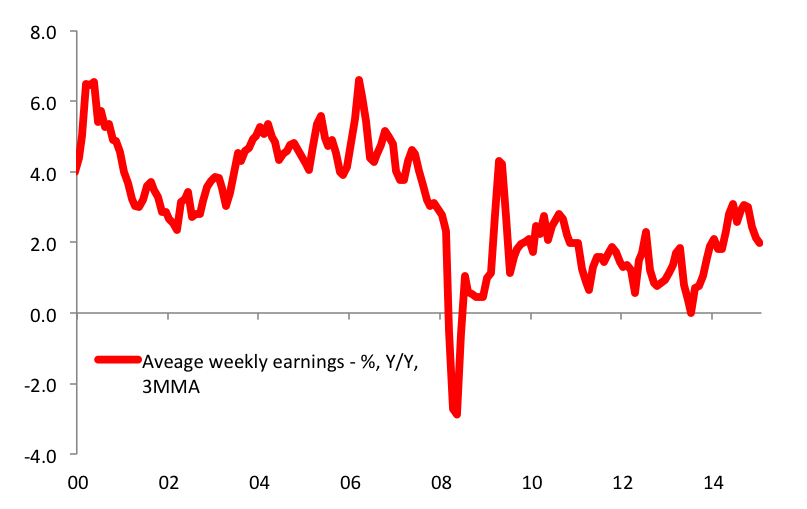
Source: CEIC
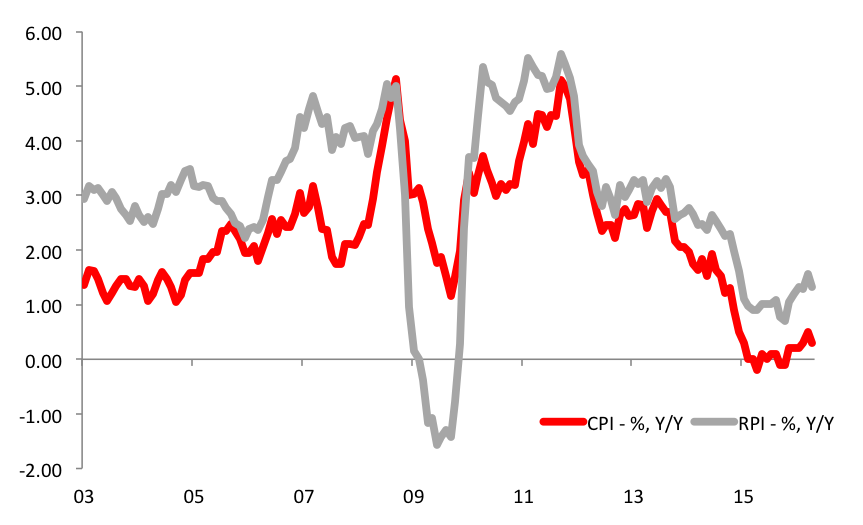
There is also little reason to fear that the inflationary consequences of a sizable GBP swoon could presage a Bank of England tightening. Throughout the post crisis period the Bank has correctly assumed that externally driven price gains would not be sustained and hence should not be countered with tighter monetary policy. (Chart 4.) With average weekly earnings in the UK currently 1.8% or less that half pre-crisis levels of 4%, it is unlikely that underlying inflation risks will concern the Bank in the event of a post-Brexit GBP slide.
In short, as a developed market, the UK would be exempt from the “Washington Concensus” policy response to currency weakness which is imposed on emerging market currencies with high exposure to foreign debt: in these countries, monetary policy is tightened pro-cyclically to stabilise the currency. ( Trading Emerging Market yield curves during currency shocks: a tale of two curves.)
Chart 4. The Bank of England has been wise to ignore imported inflation.
Source: CEIC
Gilts are cheap in the event of Brexit
Given that the markets are pricing in the potential rather than the certitude of a Brexit event, the factors above highlight that were, this outcome to occur, Gilts are cheap. The grudging Gilt longs could come to rely on their risk free exposure to counter-balance losses in the remainder of their GBP portfolio in the face of a severe left-tail scenario.
A victory for “remain” is our base assumption…
The above analysis highlights the appeal of Gilts into Brexit even in the event of broad-based capital reflux form UK markets. Unfortunately, markets work with a greater number of variables. Despite recent opinion polls, Brexit is by no means certain, and our core view remains a victory for the Remain camp. This complicates matters, since a Remain victory could be expected to lead to a rally in the GBP, GBP risk assets and a removal of the Brexit risk premium in the Gilt market. Conservatively, the 20bp rally seen in 10yr Gilts seen since opinion polls started turning in favour of the Brexit camp over the past fortnight could be swiftly retraced, and far greater losses could be seen.
…which for the brave hearted could reward tactical paid position in GBP inetrets rate markets and long-GBP positions.
The Brexit vote is therefore a decidedly unappealing investment proposition, offering left and right tail -risks in almost equal measure. One cannot even feel confident in saying that the market pricing sufficiently compensates for the risk of Brexit.
“Don’t know, don’t trade”, but if one has to then look for levels to establish GBP longs and tactical “paid” rate positions
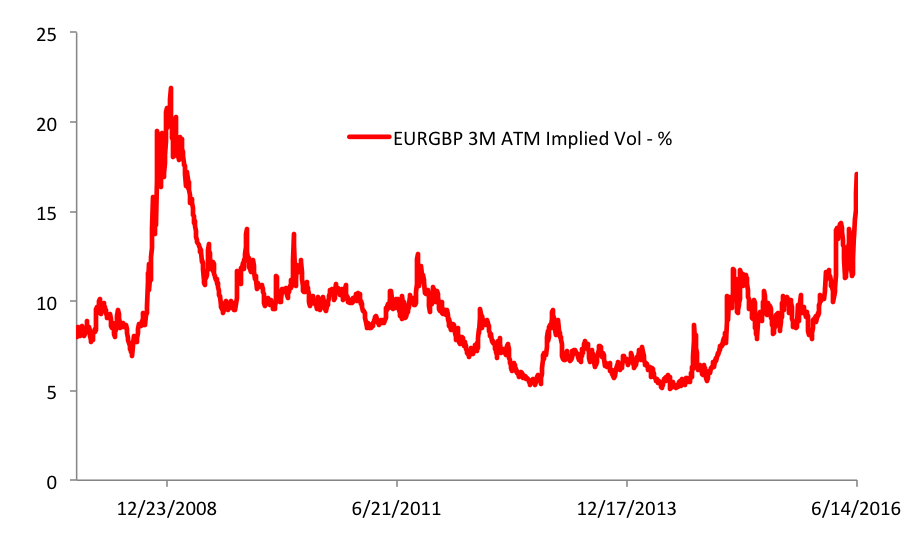
In light of this binary event, our favoured position would be a timid one – to minimise risk allocated to the UK markets around Brexit. This reflects our lack of conviction on the outcome and hence is consistent with one of our long-standing mantras: “don’t know, don’t trade”. However, if such timidity were not possible, given our bias towards a Remain victory we would be inclined to look for levels to establish tactical “paid” positions in the GBP IRS curve or short Gilt positions, but our confidence is low given the nature of the binary risk. In terms of FX markets, out bias would be to take advantage of the ensuing GBP upside and the heavy skew in the FX options market, which is approaching peak crisis levels. (Chart 5.)
Chart 5. GBP volatility and skew is approaching crisis levels
Source: Bloomberg
From a strategic perspective, long positions in Gilts continue to make sense
For investors required to maintain strategic positions in the UK interest rate market, the bias of risks would argue for continued (in many cases, grudging) long positions. In the event of Brexit, the Gilt rally would be expected to continue. While the Gilt portfolio would be expected to suffer considerable losses were Remain camp win, there are factors that could limit the scale of the selloff:
- The global and UK economies are decelerating.
- Global monetary conditions continue to ease, with the Fed’s hoped-for second rate hike looking ever more distant. (Admittedly, the risk of a needlessly hawkish Fed has been one reason why we have liked receiving USD rates from 10-years out into the tightening cycle. Is the US economy really ready for a rate hike?).
- The risk to global inflation remains skewed to the downside.
- The deepening wave of regulations combined with the application of QE creates a continued structural demand for risk free, HQLAs.
If we are right and we see a victory for Remain, then our strategic bias would be to take profit on tactical positions and look to buy Gilts/ receive GBP IRS into the sell-off. Meanwhile, for strategic investors in Gilts, the grudging longs would be well placed to remain uncomfortably long in their portfolio positioning since even with Brexit avoided, it may prove premature to call time on the multi-year and multi-decade Gilt rally.
Pingback: The danger of the Fed’s presumed US exceptionalism: real yields, “illusory alpha”, declining neutral rates and the need for core “received” positions. | Event Horizon Research
Pingback: The UK decides Brexit – An uncharted path to Tartarus? | Event Horizon Research